Helping vape users dispose of “disposable” vapes safely, from the box to the bin.
Disposable vapes contain lithium-ion batteries that start fires when they're thrown in the trash or recycling. Our team designed ReVolt: labels on the vape and its box, a website with a drop-off map, and drop-off bins, all connected by one QR code system.
- MY ROLE
- Research + design: problem framing, secondary research, usability testing, packaging and label design
- TEAM
- Seamus McPeake, Divya Mavinkurve, Hayley Jang, Yubo Zhao
- TIMELINE
- 10 weeks · Fall 2023 · UW HCDE 518
- METHODS
- Secondary research, survey, semi-structured interviews, affinity mapping, sketching, cardboard prototyping, think-aloud usability testing
- TOOLS
- Figma, Zoom, Google Workspace, pen + paper

01 · THE SOLUTION
ONE SYSTEM, FOUR TOUCHPOINTSInstead of a single product, we designed a path: every point where someone handles a vape tells them it doesn't belong in the trash, and points them to where it does.

Info sticker
Tells users not to recycle or trash the vape, explains why, and links to the ReVolt site with a QR code.
Box redesign
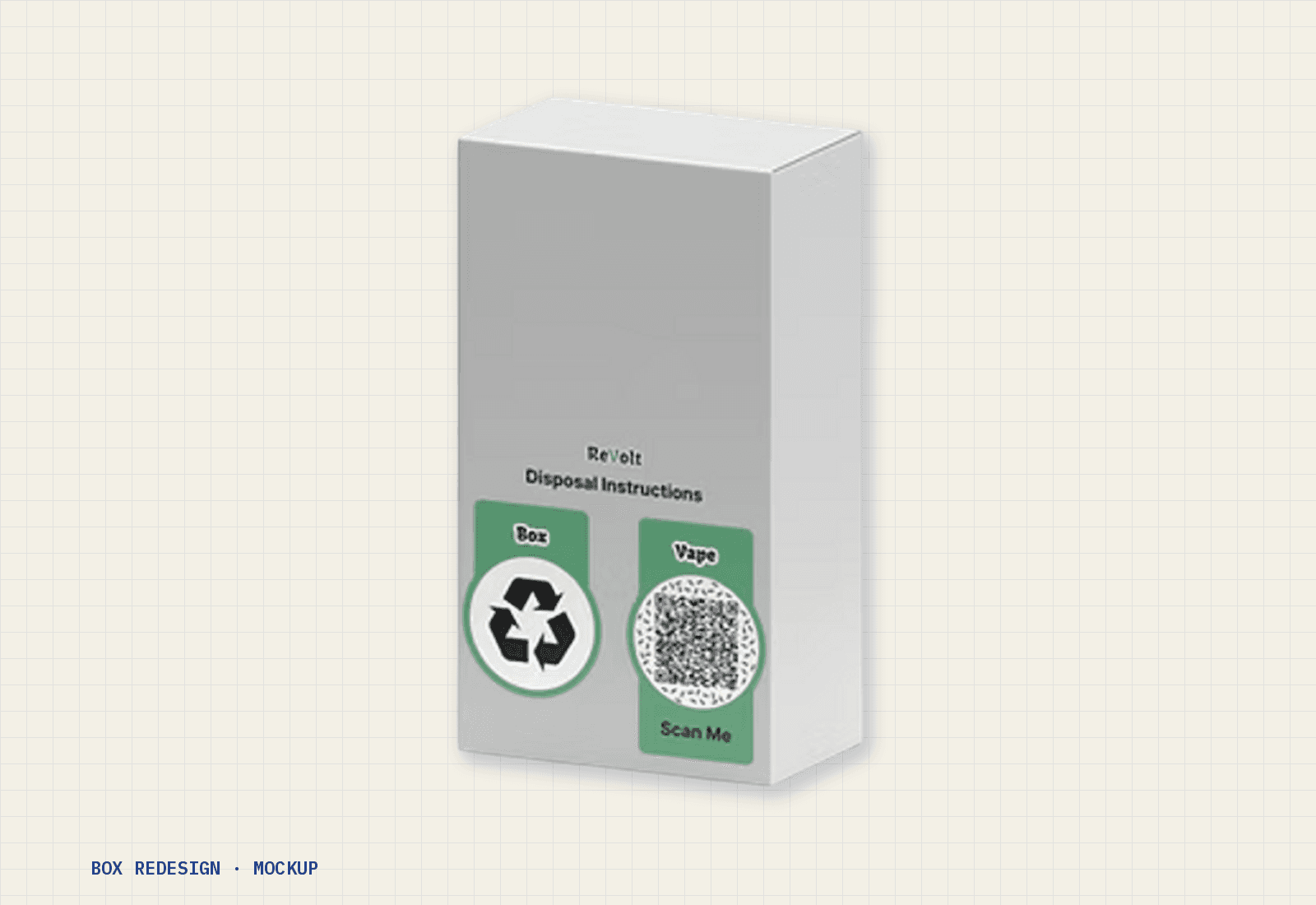
Separates the two jobs: the box is recyclable, the vape gets scanned. A labeled QR code reads “Scan Me.”

ReVolt website
A map that finds the nearest drop-off bin, plus clear explanations of why proper disposal matters.

Drop-off bin
Attaches to existing bins or sits where people vape, marked with the same symbol as the vape and box.
Every touchpoint shares the same ReVolt symbol, so the bin is easy to recognize once you've seen the label on your vape or box.
02 · THE PROBLEM
There are almost no disposal options for “disposable” vapes, and their lithium-ion batteries cause fires, chemical leaks and poor material recovery when they end up in trash or recycling.
Our team set out to design for battery disposal. While doing secondary research, I came across reports of vapes causing fires at waste facilities. I proposed shifting our focus to disposable vapes, since it was a more specific problem with no clear existing solution, and the team agreed.
WHO WE DESIGNED FORAdults (18+) who had used disposable nicotine vapes in the past year.
Sources: The Guardian, Time, Vice, Gaica, Veolia.
03 · THE RESEARCH
SECONDARY RESEARCH → SURVEY → INTERVIEWSSecondary research framed the problem. A survey then found people who use disposable vapes, and semi-structured interviews, virtual and in person, showed how they actually get rid of them.
MY PART: proposed the topic, led the secondary research, helped craft the survey, and ran interviews and usability tests.
04 · WHAT WE FOUND
2 INSIGHTSAffinity mapping our interview notes surfaced two problems: people didn't know, and even if they did, doing the right thing was a hassle.
Users are unaware
Between a lack of education on how to dispose of a vape and on why it matters, users had no idea what proper disposal looked like.
I feel like there's a lack of education about proper disposal, it's part of the reason I didn't know.PARTICIPANT

Proper disposal is inconvenient
Even people who knew it was harmful had nowhere easy to take a used vape, so the trash won by default. That included a vape store owner.
I know it's harmful, but I don't think anyone makes such efforts, and not many are aware… I wish there were better ways, but we just tell them (customers) to throw it away.PARTICIPANT · VAPE STORE OWNER

05 · IDEATION
GROUP SKETCHINGHOW MIGHT WEHow might we increase the convenience and awareness of proper vape disposal processes and techniques?
Our team ran a sketching session to generate ideas that could spread information and make disposal easier. From casing redesigns to battery changes, we went wide, then chose two directions: purpose-built community bins for convenience, and a packaging redesign with a companion website for awareness.


06 · TESTING → CHANGES
WHAT WE CHANGED BASED ON TESTINGI ran think-aloud usability tests with 4 participants using a low-fidelity prototype: a cardboard bin, a mock vape box and vape, all with QR codes and symbols, plus a mobile website prototype. Participants unboxed the vape, scanned the QR code and went through the site.

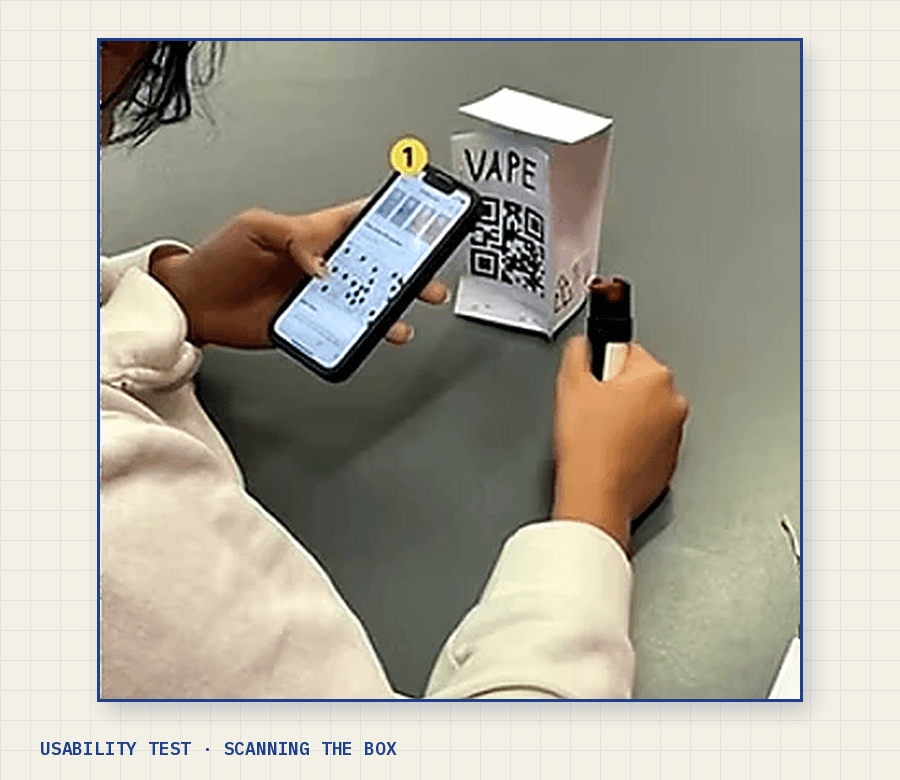
Participants didn't know what the QR code did, or what they were supposed to do with it.
We labeled every QR code with what it does: “Scan Me” on the box, and “Learn how to properly dispose of me →” on the vape's sticker.

Participants confused our disposal symbol with recycling symbols.
We split the box label in two: “Box” with the recycling symbol, and “Vape” with the QR code, so it's clear the box gets recycled and the vape doesn't.

07 · FINAL DESIGNS
MEDIUM-FIDELITY PROTOTYPESWe printed and assembled each piece to test it the way people would actually handle it.
Box redesign
A recyclable-box symbol tells users the box itself can be recycled, and a labeled QR code takes them to the ReVolt website.
Info stickers
Stickers on the vape give immediate disposal information, a reason to care (fires at waste plants), and the same QR code.

Drop-off bin
A bin that attaches to existing trash bins or objects in common vaping areas, with disposal information and a QR code to the ReVolt website.
ReVolt website
Users enter their location to find the nearest drop-off bin on a map. The site also explains proper disposal and shares statistics on the harm improper disposal causes.